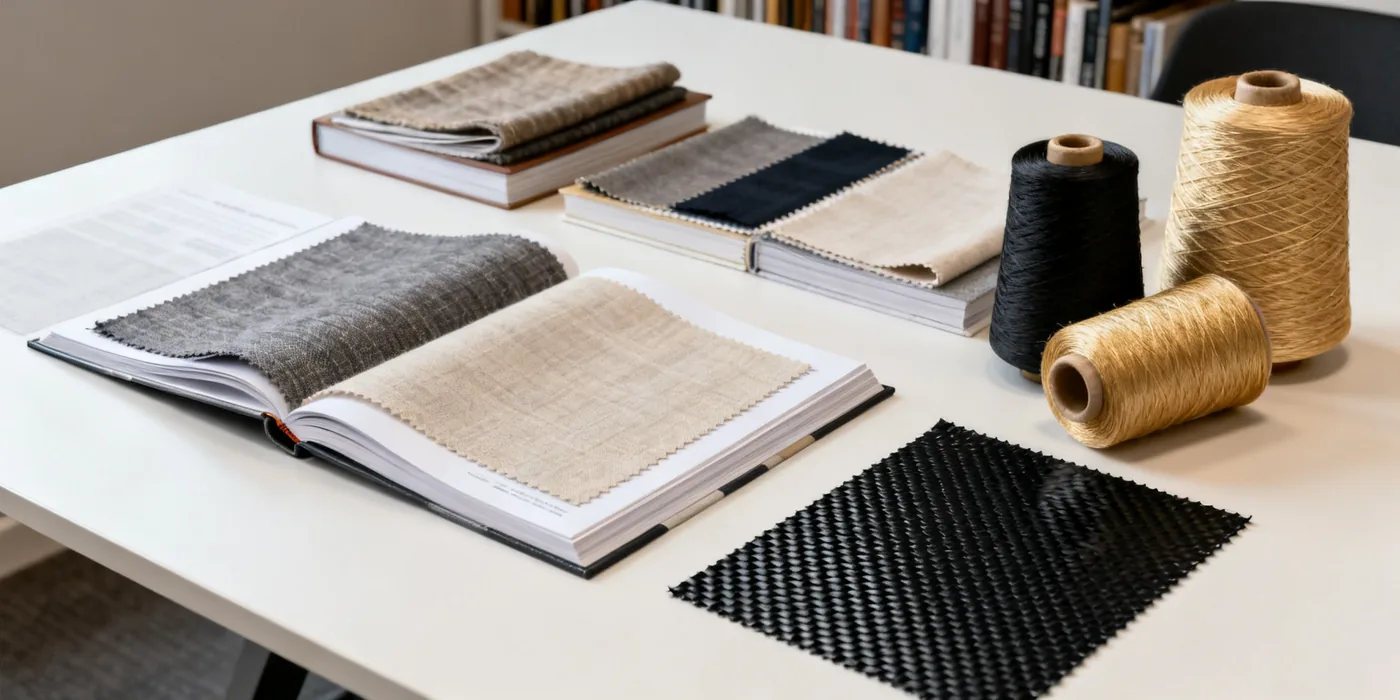
Discuss the physical material
Composition and GSM start a fabric description, but they do not finish it. An aramid protective cloth still needs its weave or knit, the yarn linear density when known, the usable width, and any finish that changes surface or heat behavior. Two cloths can share a fiber family and a nominal mass and still differ in tear path, thickness, and sewing behavior. Write those differences as observations or as questions, not as inherited performance.
Fiber and yarn language is narrower. State whether the item is staple, continuous filament, or a spun yarn, and which linear-density unit you are using. Denier and dtex should not be mixed in one line without a conversion note. A sewing thread, an aramid yarn for reinforcement, and a fiber sold for spinning are different supply formats even when the polymer family sounds similar.
Carbon fiber needs its own paragraph. Tow size, fabric style, and prepreg resin state are not synonyms. A dry reinforcement fabric and a prepreg coupon can look dark and glossy for different reasons. Keep the grade name attached to the form you actually have, and do not paste an aramid heat description onto that grade because both materials appear in industrial programs.
Discuss the intended use
Care, exposure, and processing decide which evidence is relevant. A glove or apparel program that uses protective textile may care about cut, abrasion, and comfort on the hand. An industrial barrier may care about heat and flame exposure, seam construction, and how the cloth is joined. A composite program cares about fiber alignment, areal weight, and whether the material arrives dry or pre-impregnated. Those uses can share a brand conversation and still require separate specimen notes.
When a report is cited, put the method beside the use. Abrasion, pilling, tear, tensile strength, and heat exposure answer different questions. Water resistance and moisture vapor transmission are not part of a typical aramid grade story unless the construction actually includes a coating or membrane, and they must not be assumed from the fiber name. If the use does not involve liquid water, leave that dimension out.
The business role of this page stays limited to explanation. Company size, founding year, plant count, certificate numbers, and client programs are not published here because they are not established for this site. A familiar fiber name can help a technologist find the right discussion. It does not show that this website is the certificate holder or an authorized seller. Traceability, when it matters, is a request for identifiers that link a dated specimen to a proposed order.
Worked language example, not a client program. Background: two notes used the word aramid for a sewing thread and for a protective cloth. Process: the thread was described by linear density, using dtex = denier × 0.9, and the cloth was described by weave construction, GSM in g/m², and usable width in cm. Result: tensile strength of the thread was not copied onto the cloth, and the cloth was not given a thread package format. A visible cloth can also carry a lab dip, a shade band, and a colorfastness note on a 1–5 gray scale. A hidden reinforcement does not inherit those fields. Batch traceability remains a request for identifiers, not a certificate held by this page. Lightfastness, when color is specified, is a 1–8 blue-wool scale, separate from the 1–5 staining scale. Hydrostatic head and water vapor transmission belong with coating add-on or lamination, not with the fiber name. Abrasion resistance, pilling, and seam slippage remain separate cloth notes. Roll inspection asks for the roll identifier and does not state a stock length.